Tag: Cyprus economy

  • Cyprus Business Update: Eurobank’s €400 Million Bond and Thriving Property Market

    Cyprus Business Update: Eurobank’s €400 Million Bond and Thriving Property Market

    cyprus business — Cyprus’s business landscape is showing robust signs of growth, with Eurobank announcing a significant €400 million bond issuance alongside a flourishing property market.

    • cyprus business — Cyprus's business landscape is showing robust signs of growth, with Eurobank announcing a significant €400 million bond issuance alongside a flourishing property market.
    • Investors can expect a fixed coupon of 4.125 per cent per annum, providing a steady return until the first reset date.
    • Hadjimanolis highlighted that the sector stands at a pivotal point, where leveraging technology and innovation can foster a sustainable future.
    • At the EU level, emissions intensity declined by 34 per cent during the same period, with Cyprus among the countries demonstrating substantial progress.
    • While the euro area's debt-to-GDP ratio rose to 88.5 per cent, Cyprus's decline is indicative of its strong fiscal management and economic stability.

    Cyprus business: Eurobank’s Bond Issuance

    On Friday, Eurobank S.A. confirmed the successful pricing of €400 million in fixed rate reset subordinated tier 2 notes. This issuance represents a major funding milestone for the bank, reflecting strong international investor demand.

    The notes, which are set to mature on April 29, 2037, will provide Eurobank with long-dated capital to meet its regulatory and funding requirements. The structure allows for the notes to be callable at par between January 29, 2032, and April 29, 2032, under the designation of 11.25NC6.25.

    Investors can expect a fixed coupon of 4.125 per cent per annum, providing a steady return until the first reset date.

    Real Estate Market Growth

    In parallel, the Cypriot real estate sector has recorded impressive growth. According to the Real Estate Agents Registration Council, the total value of property transfers in 2025 surpassed €4.7 billion, with a notable 15 per cent increase in sales documents compared to the previous year.

    Data from the Department of Lands and Surveys indicates that 18,114 sales documents were filed nationwide from January to December 2025, up from 15,797 in 2024. While the volume of transfers rose marginally by 0.77 per cent, the total value saw a substantial increase of around 10 per cent, indicating a shift towards higher-value properties.

    Marinos Kineyirou, president of the Real Estate Agents Registration Council, remarked, “The picture of 2025 is the clearest proof of the resilience and attractiveness of the real estate sector,” highlighting its capacity to absorb shocks from the global environment and return to a strong growth trajectory.

    Improving Banking Sector

    The Central Bank of Cyprus reported a decline in the non-performing loan ratio, showcasing ongoing improvements in the banking sector. By the end of October 2025, the non-performing loans ratio, excluding loans to central banks and credit institutions, fell to 4.2 per cent, down from 4.5 per cent in September 2025.

    Using the European Banking Authority Risk Dashboard methodology, which includes loans and advances to central banks and credit institutions, the ratio dropped to 2.1 per cent in October, down from 2.3 per cent in September, confirming a consistent downward trend in credit quality.

    Merger Notification in Banking

    In a related development, the Cyprus Commission for the Protection of Competition announced it had received a merger notification concerning the acquisition of a portfolio of non-performing loans from Alpha Bank Cyprus Limited. Cerberus Capital Management L.P., through Delta Credit Purchaser Limited, is set to acquire this portfolio, prompting a review by the competition authority.

    Resilience in the Shipping Industry

    Despite ongoing operational challenges, Cyprus’s shipping sector is demonstrating resilience. Shipping Deputy Minister Marina Hadjimanolis addressed industry representatives at the 3rd CSN Cyprus Shipping Debate in Limassol, discussing the unique challenges and emerging opportunities for the maritime sector in 2026.

    Hadjimanolis highlighted that the sector stands at a pivotal point, where leveraging technology and innovation can foster a sustainable future.

    Environmental Progress

    On the environmental front, Cyprus has reported significant reductions in greenhouse gas emissions. Eurostat data indicated that the intensity of greenhouse gas emissions fell by 28.9 per cent between 2013 and 2024, showcasing the country’s progress in decoupling economic growth from emissions.

    At the EU level, emissions intensity declined by 34 per cent during the same period, with Cyprus among the countries demonstrating substantial progress.

    Reduction in Government Debt

    Cyprus has also achieved one of the largest reductions in government debt across the European Union, with the general government gross debt to GDP ratio decreasing by 6.1 percentage points in the third quarter of 2025 compared to the previous year. This marks the third-largest decrease within the EU.

    While the euro area’s debt-to-GDP ratio rose to 88.5 per cent, Cyprus’s decline is indicative of its strong fiscal management and economic stability.

    Bilateral Trade and Investment Momentum

    The upcoming Cyprus-India Business and Investment Summit, scheduled for January 28 in Mumbai, is generating significant interest, with registrations surpassing 400. This summit aims to strengthen bilateral trade ties and position Cyprus as a gateway for Indian companies targeting European markets.

    The event will showcase Cyprus’s appeal as an international business centre, leveraging its EU membership, stable legal environment, and competitive tax structure.

    Fiscal Performance of Cyprus

    According to Eurostat, Cyprus recorded a provisional general government surplus of 2.4 per cent of GDP in the third quarter of 2025, contrasting with the broader euro area, where the deficit rose to 3.2 per cent during the same period.

    This surplus, slightly down from 2.5 per cent in the previous quarter, reflects Cyprus’s strong fiscal position, having recorded notable surpluses in previous quarters.

    Support for Women-led Startups

    The Cyprus Chamber of Commerce and Industry (Keve) is facilitating the WE-RISE Open Call 2, aimed at empowering women-led deep-tech startups in the GreenTech, AgriTech, and ClimateTech sectors. This initiative, part of the Horizon Europe programme, seeks to support 20 women-led tech startups from the EU and associated countries.

    Upcoming Tax Reforms Presentation

    Lastly, Keve announced a presentation on Cyprus’s new tax reform, scheduled for March 6, 2026, in Athens. This session aims to inform the Greek business community about changes in the tax system that will become effective from January 1, 2026.
  • CCLEI Experiences Mild Growth in November

    CCLEI Experiences Mild Growth in November

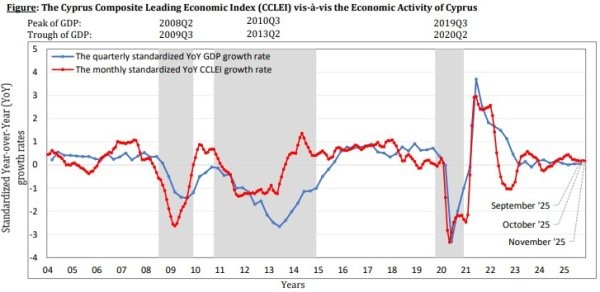
    The Composite Leading Economic Index (CCLEI) trend up in November, reflecting a mild increase in the annual growth rate for the Cypriot economy. According to a report from the University of Cyprus, the CCLEI recorded a year-on-year increase of 1.8% in November, maintaining a trajectory similar to previous months.

    Photo: financialmirror.com

    Cclei: Consistency in Economic Indicators

    This growth rate aligns closely with the CCLEI’s performance in preceding months, where it marked a 1.9% increase in October and a steady 1.8% in September 2025. The consistent figures suggest that despite various challenges, the economy is sustaining a positive outlook.

    Factors Driving Growth

    The report highlights several contributing factors that buoyed the CCLEI in November. Notably, an improvement in the weighted Economic Sentiment Indicator (ESI) for both Cyprus and the broader euro area has played a crucial role. Additionally, the positive performance across various sectors—particularly tourist arrivals, retail trade, and property sales—has provided further support for the index.

    Geopolitical Context and Economic Sentiment

    Despite the encouraging growth, the report acknowledges that this positive trajectory is unfolding amid heightened uncertainty and geopolitical tensions. The ongoing dynamics in the region are influencing economic sentiment, which remains a critical factor in future predictions.

    Energy Prices and Production Trends

    Another aspect noted in the report is the decrease in the price of Brent crude oil, which has had a beneficial impact on the economic landscape. However, not all indicators have been positive. There was a downward trend in the temperature-adjusted volume of electricity production, which is a significant component of the CCLEI. This decline has exerted a negative influence on the overall index performance for November.

    Looking Ahead

    The CCLEI’s stability suggests that while the Cypriot economy faces challenges, there are also key areas of strength that could support continued growth. The interplay between various economic factors will be crucial for maintaining this momentum in the coming months.

  • Economists Critique Government’s Tax Plan as Underwhelming

    Economists Critique Government’s Tax Plan as Underwhelming

    Economists have poured cold water on the government’s proposed tax plan, labelling it underwhelming in light of the grand promises made. Despite the government’s assertions that these changes would create a fairer tax system, analysts suggest that the reality for low-income earners is starkly different.

    Photo: cyprus-mail.com

    Tax plan: Government Claims of Reform

    The Cypriot government has touted the upcoming tax overhaul as a ‘flagship project’ aimed at strengthening the middle class and supporting low-income households. Finance Minister Makis Keravnos describes the reform as having a significant social aspect, claiming it will provide relief for families, students, and large households. He emphasised that 55 per cent of employees would see no income tax.

    Photo: cyprus-mail.com

    Legislative Timeline and Structure

    It has been 22 years since the last major revision of the tax regime. The current reform consists of six bills that the government hopes to pass swiftly, aiming for implementation by January 1, 2026. With the state budget bill also requiring attention, Parliament faces a tight deadline to deliberate on these proposed changes.

    Main Features of the Proposed Tax Reform

    The proposed changes include several key adjustments:

    • The tax-free threshold will increase from €19,500 to €20,500.
    • Families will be eligible for tax credits: €1,000 per child (or €2,000 for single-parent households), €1,000 for full-time students, a €1,500 deduction for interest on loans or rent for primary residences, and €1,000 for energy upgrades or electric-vehicle purchases.
    • To qualify for these benefits, families must have an annual income below €80,000, large families below €100,000, and single individuals below €40,000.
    • Tax deductions will extend to insurance premiums for disability and home insurance against natural disasters, allowing deductions of up to €500 per year.
    • The tax-exempt ceiling for retirement payments will rise significantly from €20,000 to €200,000.
    • All individuals aged 25 and over residing in Cyprus will need to file an income tax return, regardless of their income status.
    • The corporate tax rate will increase from 12.5 per cent to 15 per cent.

    Concerns from Economists

    Despite the government’s optimistic portrayal, economists are not convinced of the plan’s efficacy. Marios Christou, an economist from the University of Nicosia, argues that the proposals do not constitute a comprehensive tax reform. He points out that while income tax changes are notable, there is a lack of significant alteration to VAT and that low-income earners will see little benefit from the reforms.

    Christou further critiques the focus on individual rather than family income, noting that someone earning €90,000 with an unemployed spouse would not gain any tax relief from the proposed changes.

    Criticism of Tax Threshold Adjustments

    Many experts, including Savvakis Savvides, express disappointment with the minor increase in the tax-free threshold, viewing the €1,000 rise as insufficient when adjusted for inflation over the past two decades. Savvides believes the threshold should realistically be set above €25,000 to account for economic changes.

    Social Policy vs. Tax Reform

    Critics like Savvides argue that the government’s attempt to intertwine social policy with tax reform is misguided. A straightforward tax regime should not be an instrument for social policy but should instead be clear and universally applicable. He describes the proposed changes as a “complex labyrinth” that introduces unnecessary complications under the guise of social justice.

    Concerns About Political Accountability

    Additionally, Savvides suggests that President Nikos Christodoulides may be using these amendments to deflect criticism regarding his failure to deliver on campaign promises, such as raising the tax threshold to €24,000. This raises questions about the administration’s commitment to genuine reform.

    Economic Implications

    As the government moves forward with its tax plans, economists caution that the proposed changes may not yield the intended economic benefits. The focus on middle-class relief, while neglecting the low-income demographic, could lead to greater economic disparities.

    Ultimately, while the government presents the tax reform as a significant step toward a fairer system, the lack of comprehensive changes and the criticisms from leading economists suggest a more cautious interpretation of its impact.

  • CCLEI Reports Moderate Growth in June Amid Economic Pressures

    CCLEI Reports Moderate Growth in June Amid Economic Pressures

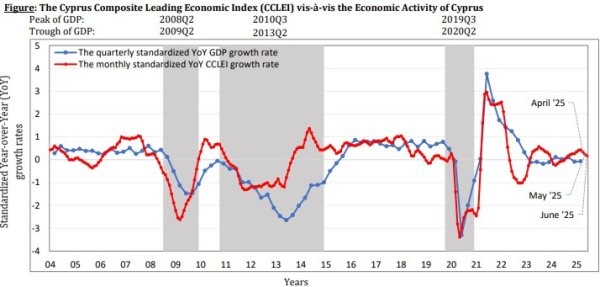
    The Cyprus Composite Leading Economic Index (CCLEI) sees moderate growth in June 2025, indicating a continued but tempered upward trend in the country’s economic outlook, according to a report from the University of Cyprus.

    Photo: financialmirror.com

    Constructed by the Economics Research Centre (CypERC), the CCLEI recorded a year-on-year increase of 2.3% in June, reflecting a decrease from previous months, which saw growth rates of 2.6% in May and 3.1% in April. This moderation points to a slowdown in the growth rates of individual indicators that feed into the index.

    Significantly, the report highlights that the economic climate in the euro area has deteriorated, contributing to the slowdown. This aligns with a weakening growth rate of the Economic Sentiment Indicator (ESI) in Cyprus, suggesting that broader economic pressures are at play. Additionally, weekly data on electricity production, adjusted for temperature, showed a decline in annual growth rates.

    Despite these challenges, several factors supported the growth of the CCLEI. Positive contributions stemmed from various sectors, including property sales, an increase in tourist arrivals, and a rise in transactions made with Cypriot credit cards. Retail trade sales volume also showed encouraging signs, suggesting resilience in domestic consumption.

    Furthermore, a notable decline in Brent crude oil prices over the same period has provided some relief, potentially easing inflationary pressures that could affect consumer spending and investment. This combination of factors indicates a complex economic landscape where growth is being bolstered by specific sectors, even as challenges loom from external conditions.

    The report’s authors caution that the geopolitical conflicts in the Middle East could significantly impact international energy markets. This ongoing uncertainty necessitates careful monitoring and assessment of the medium-term economic prospects for Cyprus. As external pressures mount, the economic outlook remains cautiously optimistic yet vigilant.