Tag: employment law

  • Sexual harassment — Supreme Court Rules in Favour of Woman Dismissed After Reporting Sexual Harassment

    Sexual harassment — Supreme Court Rules in Favour of Woman Dismissed After Reporting Sexual Harassment

    The Supreme Court has awarded €37,700 to a woman fired by the Electricity Authority of Cyprus scientific staff union after she filed a sexual harassment complaint against one of its executive members.

    • The court upheld her appeal and overturned a previous Labour Disputes Court decision that had rejected her claim, ruling that the union failed to ensure a fair and impartial investigation process.
    • The Labour Disputes Court initially rejected her application, asserting that her dismissal was not due to the complaint itself but rather her behaviour during the investigation process.

    The court upheld her appeal and overturned a previous Labour Disputes Court decision that had rejected her claim, ruling that the union failed to ensure a fair and impartial investigation process.

    This case originated from an application filed in 2009 under the 1967 Annual Leave with Pay Law and the 2002 Equal Treatment of Men and Women in Employment Law. The woman, who was hired as a secretary in 2000, claimed she was unlawfully dismissed after being fired without notice on 31 July 2008.

    On 19 June 2008, she made a formal complaint stating that an executive committee member had been sexually harassing her for years. Following her complaint, the executive committee initiated an investigation on 23 June 2008, adhering to its code of practice for handling sexual harassment cases. The implicated official was informed he would not take part in the investigation.

    During the investigation meeting, the woman requested to have three supporters accompany her while giving testimony, a request that was granted. However, the minutes from the meeting indicated that her behaviour was perceived as confrontational, leading to her being placed on paid leave.

    After being given deadlines to present evidence to support her claims, the union concluded on 22 July 2008 that her complaint was “unfounded, unsubstantiated, and false,” and subsequently dismissed her on 31 July 2008, the same day she was summoned to respond but did not attend.

    The Labour Disputes Court initially rejected her application, asserting that her dismissal was not due to the complaint itself but rather her behaviour during the investigation process.

    Upon reviewing the case, the Supreme Court determined that the union had an obligation to conduct a fair and impartial investigation, particularly since one of its officials was the subject of the complaint. The court found that the principle of impartiality was not upheld, rendering the summary dismissal unlawful. As a result, the court did not explore other grounds for appeal, as the violation of impartiality was sufficient for the judgement.

    The court awarded the woman €37,700, along with legal interest from the date of the initial decision and costs in her favour for both the first instance and the appeal. No costs order was issued against the respondent, marking a significant ruling in her favour.
  • Disabled Employee Alleges Discrimination in Promotion Process

    Disabled Employee Alleges Discrimination in Promotion Process

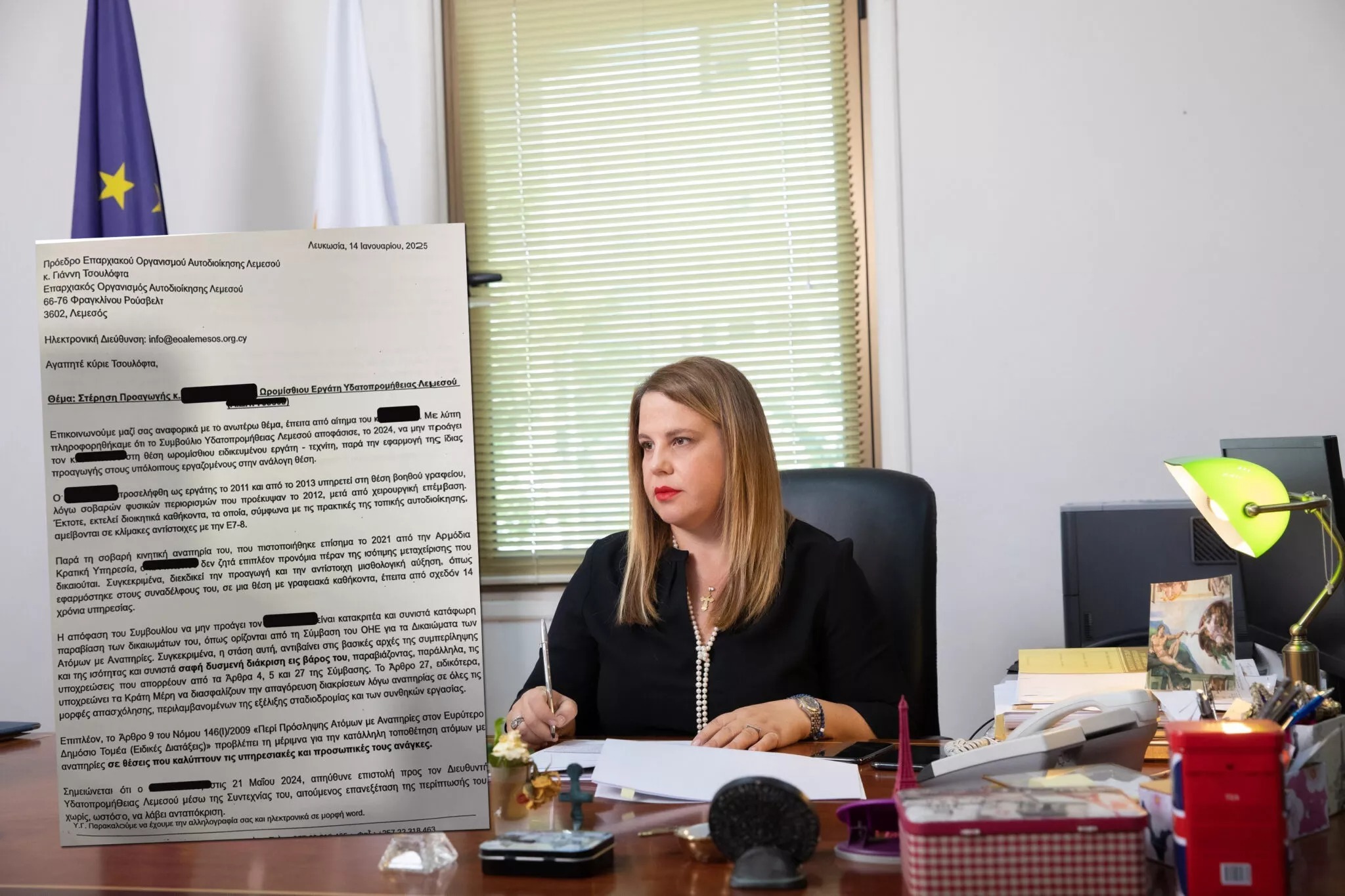
    An employee with disabilities claims he was unfairly denied a promotion, sparking a complaint to Cyprus’ Commissioner for Administration and Human Rights. The complaint, filed last Thursday by lawyer George Karapatakis, represents a former employee of the Limassol Water Board, which has been dissolved and integrated into the Limassol District Local Government Organisation (EOA).

    The complainant, a father of three, suffers from a serious spinal disability following surgery. Despite his challenges, he has continued to fulfil his job responsibilities from a different position with commitment. Notably, he is not wheelchair-bound and manages to commute independently.

    Karapatakis argues that his client was overlooked during a promotion process at the Limassol Water Board in spring 2024. He asserts that this decision was influenced by the employee’s health condition. To support this claim, the lawyer references the promotion of two other workers who had been appointed in the same year as his client, suggesting that the promotion criteria may not have been applied consistently.

    In his appeal, Karapatakis draws attention to the fact that individuals with disabilities are typically promoted within security bodies like the Police and National Guard without negative repercussions. He also mentions similar practices in the Civil Service and the wider public sector, implying that his client’s situation is an exception rather than the norm.

    The issue is complicated by the status of the Limassol Water Board, which no longer exists as a legal entity. In a response letter, Sokratis Metaxas, the General Director of the EOA and former director of the Water Board, stated that there is no authority to intervene in previous promotions because of this dissolution. He acknowledged that he participated in the promotion process in question.

    Metaxas addressed the situation after being informed of the complaint. While he refrained from discussing specific personal circumstances, he emphasised that the contributions of the affected employee would be recognised and valued in the future. He defended the promotion decisions made, asserting that they were in the best interest of the service and reflected appropriate sensitivity to all employees’ circumstances.

    The legal argument presented in the complaint highlights the serious implications of alleged discrimination based on disability. It references relevant legislation and European directives, stressing that employment for individuals with significant disabilities is essential for their self-esteem, social integration, and personal fulfilment. Karapatakis states, “Work not only enhances the physical and psychological well-being of these individuals but also reduces the feeling of isolation.”

    The complaint concludes with a strong assertion that discrimination has occurred in the employee’s career development due to his disability. Karapatakis hopes for decisive action from the Commissioner, urging that the alleged discrimination be addressed.