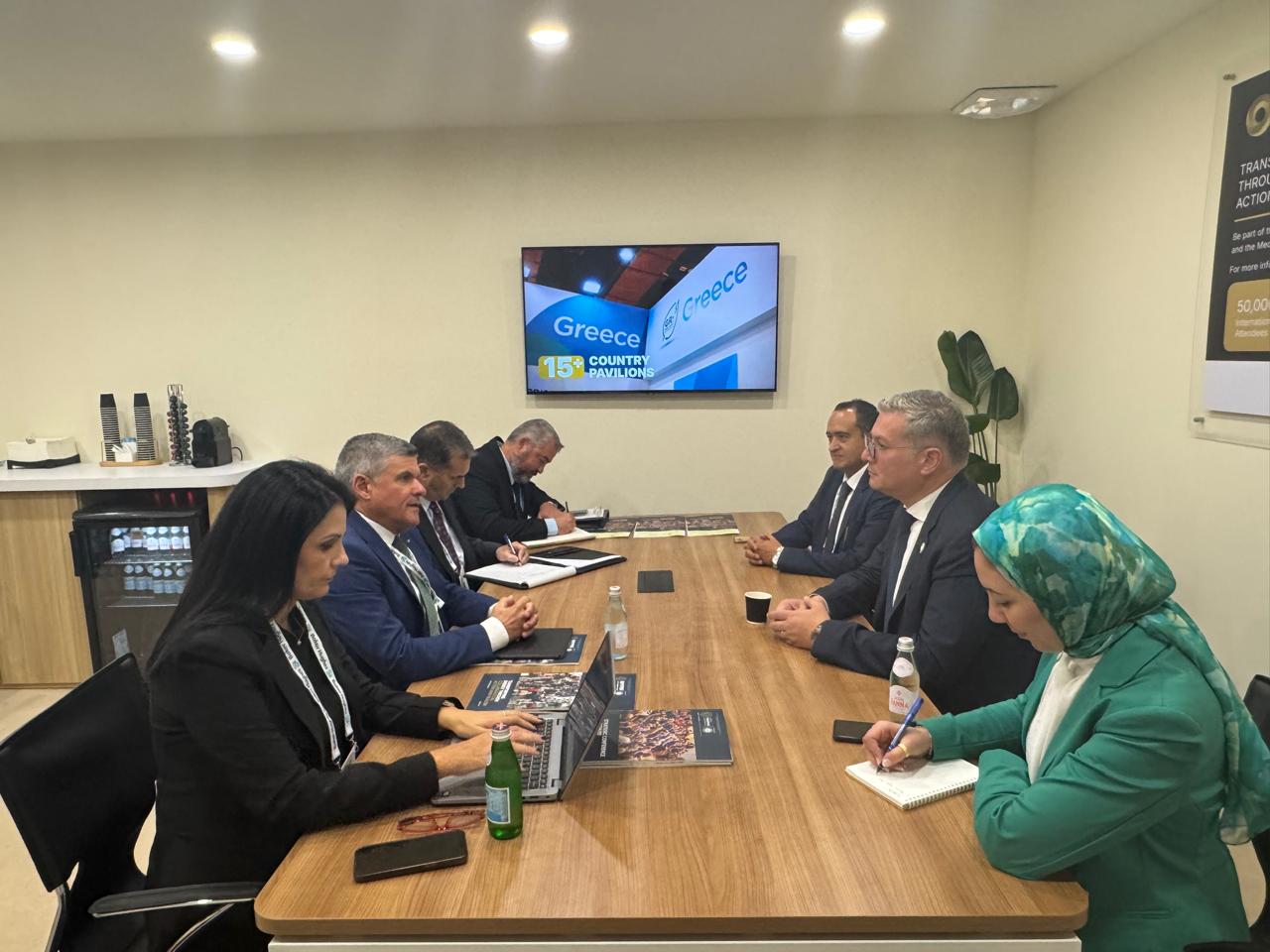
Energy Minister George Papanastasiou met with Egypt’s Petroleum Minister Karim Badawi on Tuesday for a significant discussion focused on natural gas exploration in Cyprus’ maritime exclusive economic zone (EEZ).

Photo: cyprus-mail.com
- Papanastasiou also held discussions with Total’s CEO Patrick Pouyanne and Eni’s COO Guido Brusco on the same day, reinforcing the collaborative spirit between the companies.
During their meeting, which Papanastasiou described as “results-oriented,” the two ministers aimed to expedite the connection of the Kronos natural gas field, located in Block 6 of Cyprus’ EEZ, to Egypt’s energy infrastructure by 2027.

Photo: cyprus-mail.com
This meeting followed a recent visit by Badawi and other Egyptian officials to Nicosia, where they announced plans for the export of Cypriot natural gas to Europe via Egypt in the coming years. Achieving this target hinges on a final investment agreement between the Egyptian government and the consortium of French multinational Total and Italian energy company Eni, who are responsible for the development of the Kronos field.
In February, the Egyptian government was designated as the “host government” for Block 6, a crucial step towards facilitating the exploitation of these resources. Given the proximity of the Kronos reservoir to Egypt’s Zohr gas field, Eni has the advantage of leveraging its existing infrastructure to transport the natural gas to the Segas liquefied natural gas (LNG) terminal in Damietta.
Papanastasiou also held discussions with Total’s CEO Patrick Pouyanne and Eni’s COO Guido Brusco on the same day, reinforcing the collaborative spirit between the companies.
Last week, he emphasised that the planned agreements would encompass the entire supply chain, from the liquefaction of natural gas in Damietta to its eventual export to European markets. Seabed surveys intended to identify a sinking point for the pipeline connecting Cyprus’ EEZ to Egypt commenced in June, initially focusing on transporting gas from the Aphrodite gas field.
This initiative followed an agreement signed by the governments of Cyprus and Egypt, along with American corporation Chevron, Israeli company NewMed Energy, and BG Group (owned by Royal Dutch Shell). This agreement, according to the Cypriot government, aimed to establish a framework for the effective commercialisation of the gas resources in the region.
In their recent discussions, Badawi highlighted the potential for further collaboration between Cyprus and Egypt in the energy sector. While the initial focus remained on the Kronos gas field, he acknowledged ongoing efforts regarding the development of the Aphrodite gas field, situated in Block 12 of Cyprus’ EEZ. He noted that substantial progress had been made, reiterating the importance of their partnership.
“Our cooperation in the energy sector with the Republic of Cyprus is very important and is expanding daily,” Badawi stated. “We are here to support the Republic of Cyprus in the full development of its energy reserves, so that it can exploit them and make them available to its citizens and to European markets which need energy.”