
Tag: Eurostat

  • Cyprus Struggles with Lowest Forest Growth Rate in EU

    Cyprus Struggles with Lowest Forest Growth Rate in EU

    Cyprus recorded the lowest forest growth rate among EU member states in 2023, at just 1.6 per cent, according to data released by Eurostat on Friday.
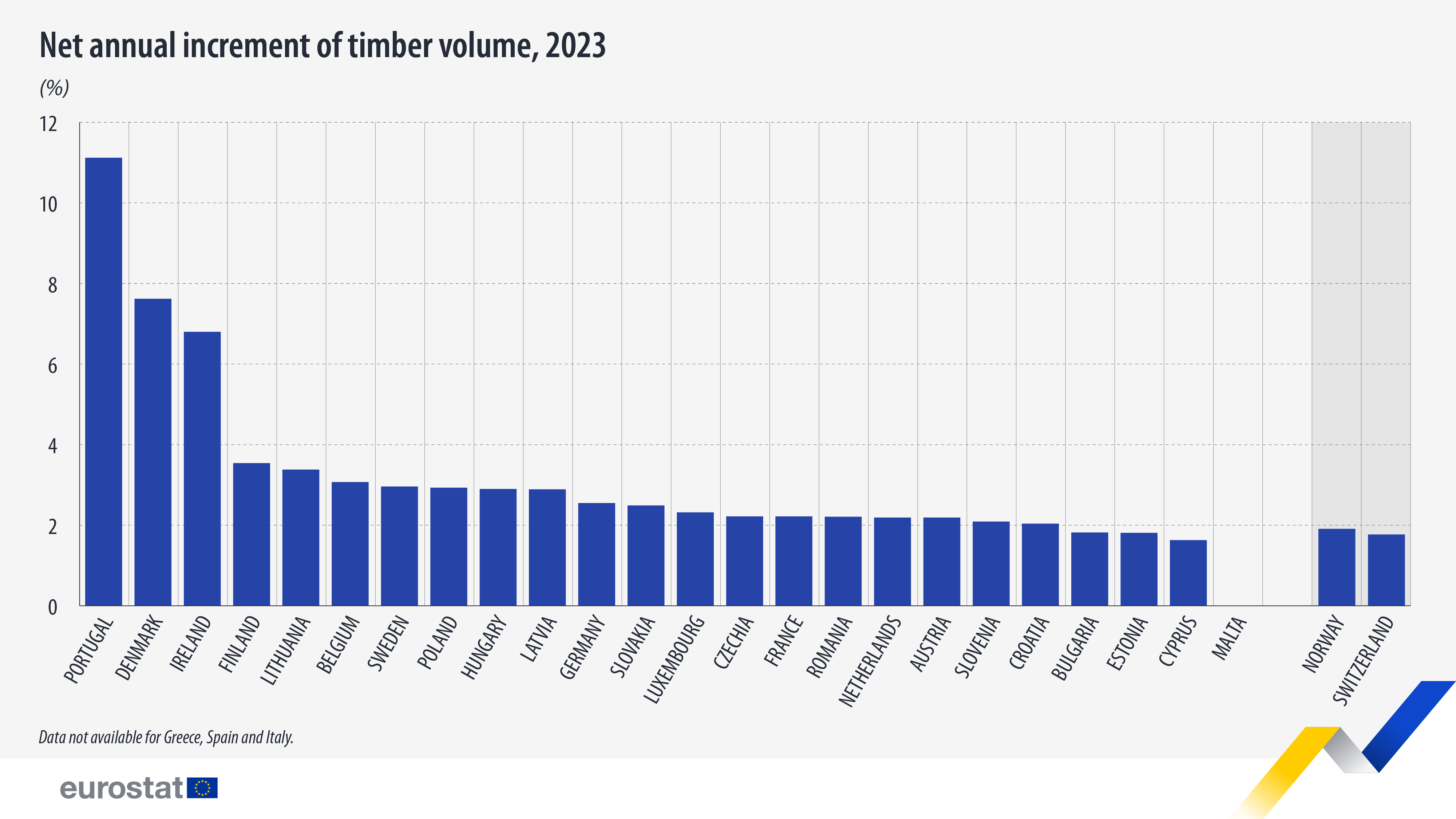
    Photo: cyprus-mail.com

    • Cyprus recorded the lowest forest growth rate among EU member states in 2023, at just 1.6 per cent, according to data released by Eurostat on Friday.

    This alarming statistic places Cyprus at the bottom of the EU ranking, alongside Malta, which saw no forest growth at all. Bulgaria and Estonia are not far behind, both achieving a modest growth rate of 1.8 per cent. In stark contrast, Portugal boasts the highest growth rate in the EU at 11.1 per cent, followed by Denmark at 7.6 per cent.

    State forest land in Cyprus encompasses approximately 18 per cent of the island’s total area, featuring a mix of natural pine forests, reforested areas, grasslands, and other non-forested lands such as dams and mining sites. Despite this coverage, the low growth rate indicates significant challenges for the island’s forestry sector.

    Eurostat’s data reveals that Cyprus is also among the EU member states with the lowest net growth of timber stock. This situation contrasts sharply with countries like Ireland and Latvia, which report significantly higher net growth rates. The implications of these figures extend beyond mere statistics; they highlight the ongoing struggle for sustainable forest management in Cyprus.

    As forest growth plays a vital role in the EU’s strategy for sustainable forest management and climate goals, Cyprus’s situation raises concerns about its future environmental stewardship. The Cypriot government has acknowledged these challenges, focusing its forestry management on environmental protection, biodiversity conservation, and recreational opportunities. This shift represents a deliberate move away from prioritising timber production towards achieving broader social and environmental benefits.

    However, the forestry department also pointed out that this approach has resulted in limited domestic timber production. Consequently, Cyprus relies heavily on timber imports from both EU member states and third countries to satisfy local demand. This dependency underscores the urgent need for a re-evaluation of forest management practices on the island.

    The forestry sector in Cyprus faces a complex situation: while there is a clear commitment to environmental sustainability, the numbers indicate that immediate action may be necessary to enhance forest growth and ensure the island’s ecological health. As Cyprus navigates these challenges, the future of its forests will be pivotal in shaping not only its environment but also its economy.

  • Cypriots Move Out of Family Home at 27, Revealing EU Trends

    cypriots — Young adults in Cyprus typically leave the family home at an average age of 27.2, marking them as some of the oldest in Europe to do so, according to data from Eurostat. This places Cyprus in a notable position within the EU, where the average age for leaving home varies widely across different countries.

    Cypriots: Comparative Age Trends Across Europe

    Cyprus ranks among the countries with the latest average ages for young people moving out, trailing only Croatia, where the average is 31.3 years, and Slovakia and Greece, with averages of 30.9 and 30.7 years, respectively. In contrast, Scandinavian nations reflect a different trend, with young Swedes leaving home as early as 21.9 years, followed closely by Danes at 21.7 and Finns at 21.4.

    Housing Costs and Young Adults

    The Eurostat data highlights that young people aged 15 to 29 are increasingly burdened by housing costs. Approximately 9.7 per cent of them spend 40 per cent or more of their income on housing, compared to 8.2 per cent of the general population. This financial strain varies significantly across the EU, with Greece experiencing the highest rate of housing cost overburden at 30.3 per cent, followed by Denmark at 28.9 per cent.

    Contrasting Situations in Cyprus

    In Cyprus, however, only 2.8 per cent of young people face severe housing cost burdens, placing it among the countries with the lowest rates in the EU. This statistic suggests that lower housing costs may be linked to the later age at which young adults leave home. While many Cypriots stay under their parents’ roofs longer, they do so in a context where housing remains relatively affordable.

    Broader Implications for Young Adults

    The tendency for young people to remain at home longer in Cyprus and some other countries correlates with a lower incidence of housing cost overburden. This relationship indicates that while delayed independence may offer financial relief in terms of housing, it also raises questions about the social implications of prolonged dependency on parental support.

    In contrast, Greece’s situation illustrates a complex dynamic: despite young adults leaving home later, they grapple with high housing costs, creating a challenging environment for financial independence.

  • Tertiary education — Cyprus Achieves Third Highest Tertiary Education Completion Rate in EU at 60.1%

    Tertiary education — Cyprus Achieves Third Highest Tertiary Education Completion Rate in EU at 60.1%

    In 2024, Cyprus ranked third in the EU regarding tertiary education completion rates, achieving 60.1%. This impressive figure places the nation behind only Ireland, which leads at 65.2%, and Luxembourg at 63.8%, according to data from Eurostat.

    The tertiary education completion rate reflects the percentage of individuals aged 25 to 34 who have successfully obtained a higher education qualification. This metric serves as a key indicator of progress towards the fourth Sustainable Development Goal, which emphasises the importance of quality education for all.

    The EU as a whole has also shown commendable progress, with the tertiary education completion rate rising to 44.1% in 2024. This marks a notable increase from 39.6% in 2019, suggesting that the EU is on course to meet its 2030 target of achieving at least 45%.

    However, the statistics reveal disparities among member states. Romania, Italy, and Hungary reported the lowest completion rates, standing at 23.2%, 31.6%, and 32.3% respectively. Such figures highlight the varying levels of educational achievement across the continent.

    Gender differences in educational attainment also present a significant concern. Across the EU, women recorded a completion rate of 49.8%, while men lagged behind at 38.6%. This trend indicates that young women are outpacing their male counterparts in obtaining tertiary qualifications.

    Some countries exhibit a pronounced gender gap. Slovenia, for example, shows a staggering difference of over 20 percentage points, with women achieving a completion rate of 55.7% compared to just 32% for men. Similar gaps are evident in Latvia, Estonia, and Croatia, where young women consistently exceed young men in educational attainment.

    As Cyprus continues to excel in educational achievements, the importance of access to quality education remains paramount. The focus now shifts to maintaining these high standards and addressing the existing inequalities, particularly in gender representation within higher education.

  • International students — Cyprus Ranks Third in EU for International Students

    International students — Cyprus Ranks Third in EU for International Students

    Cyprus has emerged as a leading destination for international students, ranking third among EU member states with nearly one in four university students hailing from abroad, according to Eurostat data released on Friday.

    Prominent Statistics Highlighting Cyprus’ Appeal

    In 2023, Cyprus welcomed a significant number of international students, with the figure standing at 22.3% of its total tertiary education enrolment. This statistic is a testament to the country’s growing reputation as an attractive locale for higher education.

    Across the EU, the total number of foreign students engaged in tertiary-level studies reached 1.76 million, making up 8.4% of all students. These numbers reflect a broader trend towards the internationalisation of higher education across Europe.

    Leading EU Nations in International Student Enrolment

    Luxembourg leads the EU with a remarkable 52.3% of its tertiary students coming from foreign countries, making it the most internationalised higher education system in the bloc. Malta follows closely with 29.6%, while Cyprus occupies a commendable third place.

    This trend contrasts sharply with Greece, Croatia, and Spain, which reported much lower percentages of international students, at 3%, 3.7%, and 4.3% respectively. This disparity highlights Cyprus’s unique positioning within the region.

    Origin of International Students in Europe

    The majority of foreign students in EU universities come from within Europe. Slovakia boasts the highest percentage of European students at 91.3%, followed by Slovenia at 89.4% and Croatia at 89%. This indicates strong intra-European mobility among students.

    In contrast, students from Asia dominate in countries like Ireland, Finland, and Germany, with notable percentages of 45%, 43.35%, and 40.1% respectively. This diverse influx enriches the cultural fabric of educational institutions across the continent.

    Regional Trends in International Student Demographics

    France and Portugal present interesting statistics as well, with more than half of the foreign students in France (52.3%) originating from Africa. Similarly, Africa also constitutes the largest group of foreign students in Portugal, at 42.1%. This trend signifies the growing educational connections between these regions.

    Spain shows a different demographic, with a substantial 46.7% of its foreign tertiary students coming from the Caribbean, Central, and South America. This highlights the varied international student landscapes across Europe.

    Cyprus’ Growing Reputation

    The data signifies a notable shift towards the internationalisation of Cypriot universities, making them appealing to foreign students seeking quality education in a diverse environment. The Cypriot education system’s capacity to attract such a significant proportion of international students is indicative of its strengths and the efforts made to enhance its global outreach.

  • Long working — Cyprus Ranks Second in the EU for Long Working Hours

    Long working — Cyprus Ranks Second in the EU for Long Working Hours

    Cyprus has been identified as the second-worst country in the EU for long working hours, with 10 per cent of its workforce putting in 49 hours or more per week, according to Eurostat’s latest report. This figure places Cyprus just behind Greece, which has the highest rate at 12.4 per cent.

    • These variations raise questions about work culture and economic conditions in different member states, as well as the effectiveness of labour regulations and protections.
    • As these statistics reflect broader themes of work culture and economic reality in Cyprus, they also point to the need for ongoing dialogue about work-life balance and employee welfare.

    Eurostat’s findings reveal that the EU average of workers engaged in long hours stands at 6.6 per cent. While this data illustrates a concerning trend in both Cyprus and Greece, it also indicates an improvement over the years.

    European Trends in Long Working Hours

    The report highlights a gradual decline in the percentage of EU workers facing long hours. In 2014, the figure was as high as 9.8 per cent, dropping to 8.4 per cent by 2019. This downward trend suggests that, while long working hours remain a challenge, there is a slow but positive movement towards better work-life balance across Europe.

    Comparative Analysis of Member States

    In the context of long working hours, Cyprus’s 10 per cent is significant compared to several other EU nations. Following Greece, France is close behind with 9.9 per cent. In stark contrast, countries with the lowest rates include Bulgaria at 0.4 per cent, Latvia at 1 per cent, and Lithuania at 1.4 per cent.

    These variations raise questions about work culture and economic conditions in different member states, as well as the effectiveness of labour regulations and protections.

    The Self-Employed and Long Hours

    Interestingly, the self-employed demographic in Cyprus experiences a much higher incidence of long working hours, with 27.5 per cent working 49 hours or more weekly. This is substantially higher than the 3.4 per cent of employees who report long hours. This disparity raises concerns about the pressures faced by self-employed individuals, who often work longer to sustain their businesses.

    Occupational Groups Most Affected

    Certain occupational groups are also more prone to long working hours. According to the international standard classification of occupations (Isco), skilled agricultural, forestry, and fishery workers represent the highest percentage at 26.2 per cent. Following closely are managers, with a significant 21.1 per cent also reporting long hours.

    As these statistics reflect broader themes of work culture and economic reality in Cyprus, they also point to the need for ongoing dialogue about work-life balance and employee welfare.