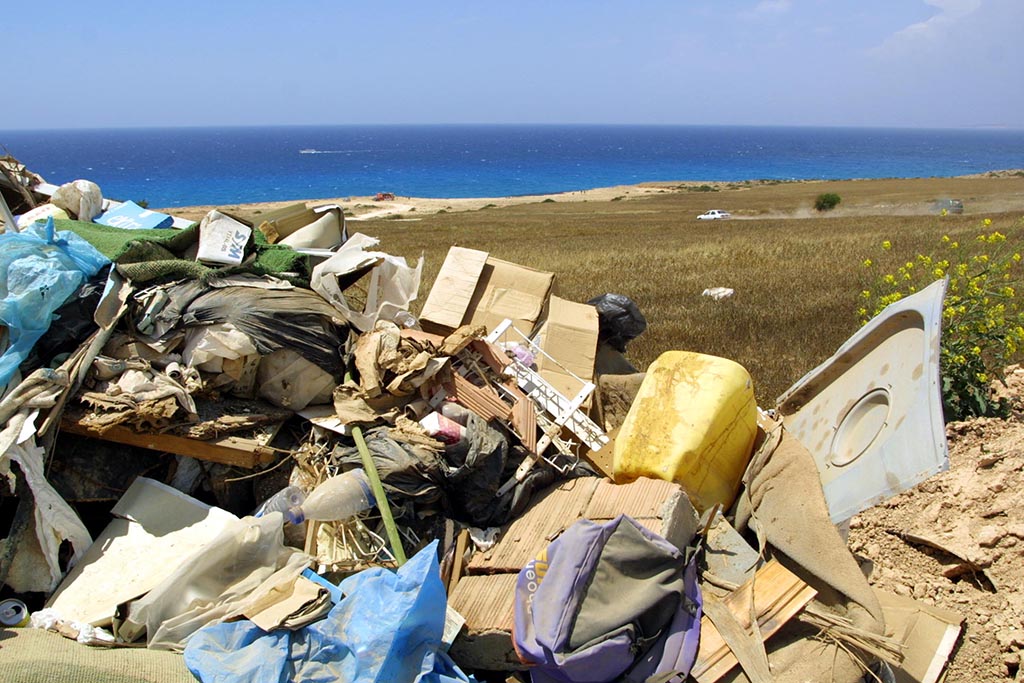
environmental neglect — Cyprus is grappling with severe environmental neglect, highlighted by the presence of over 540 illegal rubbish dumps in Paphos alone. Reports indicate that waste is being carelessly dumped in state forests, such as in Pelendri, where debris is obstructing vital fire lanes. Furthermore, office furniture from state authorities has been abandoned in open fields in Yeri, illustrating a troubling disregard for proper waste management.

Photo: cyprus-mail.com
In a country where beaches are often littered with trash, clean-up efforts are sporadically initiated, primarily by private individuals rather than state initiatives. This neglect has prompted various organisations to raise alarms about Cyprus’ environmental protection record.
In early August, an audit report revealed a “significant reluctance on the part of the state to adopt drastic and immediate measures” to tackle these violations. The situation is compounded by the European Union’s ongoing scrutiny, with Cyprus currently facing 16 active infringement procedures related to environmental issues.
“For years the European Commission has identified that in Cyprus there is a systemic abuse of Article 6.3 of the Habitats Directive regarding the environmental appropriate assessment of projects in Cyprus,” said Tassos Shialis, BirdLife campaign coordinator. He pointed out that in March 2024, the European Commission escalated an infringement case to the European Court of Justice, urging Cyprus to take corrective measures for what he termed a “chronic problem.”
Despite repeated warnings, Shialis noted that improvements in the application of environmental assessment procedures have been minimal. Large-scale projects, in particular, continue to be approved without adequate scrutiny, posing significant threats to Natura 2000 sites and protected species.
The EU has a structured process for addressing such breaches, beginning with a letter of formal notice and potentially leading to fines if compliance is not achieved. In March 2024, the Commission reported that Cyprus had designated 37 special areas of conservation but had failed to establish necessary conservation measures for 28 of them. Furthermore, the objectives in place for five of these sites were deemed insufficient to protect local ecosystems.
This pattern of negligence has persisted since Cyprus received its first letter of formal notice in June 2021, followed by a reasoned opinion in April 2022. The Commission’s referral to the Court of Justice highlights ongoing failures to safeguard critical habitats and species.
According to the audit report issued in August, the state has shown a consistent disregard for EU environmental laws, with violations spanning urban planning, waste management, and habitat protection. Key examples include illegal developments in Ayia Thekla and Kouklia, as well as unauthorised constructions within Natura 2000 zones in Akamas.
The report also details how the Lakatamia environmental centre was constructed without conducting an environmental impact study, illustrating a troubling lack of enforcement of existing laws. Although the regulations are in place and violators are known, the lack of effective law enforcement raises serious concerns.
The responsibility for Cyprus’ environmental failures is complex and multifaceted. While the government holds a significant portion of the blame, the country’s ranking of 32nd out of 34 in a recent EU comparison highlights a concerning trend in environmental backsliding. Despite commitments to the UN’s Sustainable Development Goals, progress remains slow.
Local projects often emerge in collaboration with municipal authorities, but approval processes can be convoluted, involving multiple stakeholders, including private companies. The overlapping responsibilities of various government departments, local municipalities, and regulatory bodies complicate efforts to address everyday environmental issues, such as illegal dumping and pollution.
The environment department, while responsive to inquiries, acknowledges the tangled web of accountability, making it challenging to pinpoint who is ultimately responsible for the growing waste crisis. Director Theodoulos Mesimeris stated, “According to the law, local authorities are responsible for the cleaning and illegal dumping of waste.” This fragmented responsibility contributes to the ongoing environmental challenges faced by Cyprus.