Tag: public sector

  • Gender Perspective Essential in New Legislative Bill

    Gender Perspective Essential in New Legislative Bill

    A bill to integrate gender equality into the executive, legislative and judicial elements in the public and broader public sector was discussed at the House legal affairs committee on Wednesday.

    • A bill to integrate gender equality into the executive, legislative and judicial elements in the public and broader public sector was discussed at the House legal affairs committee on Wednesday.
    • Ioannou articulated that society expects the House of Representatives to address serious issues, highlighting the complexity of integrating gender perspectives into legislation.
    Gender equality commissioner Josie Christodoulou underscored the necessity of addressing the different needs of women and men during her comments after the meeting. “Women and men have different needs, and we should take into account the different impact of every policy or action and every bill on women and men,” she stated.

    Christodoulou highlighted that ensuring equality needed to be a fundamental aspect of drafting legislation and policies to eliminate gender-based discrimination. She cited the example of single parenting and the specific needs of women with disabilities as critical considerations that the proposal, submitted by House president Annita Demetriou, aims to address.

    Commendable practices already adopted in Cyprus, such as yellow parking spots for pregnant women and families with strollers, were mentioned by the commissioner as examples of how local government is beginning to take these needs into account.

    Furthermore, the commissioner pointed to successful incorporation of gender dimensions in policy processes elsewhere, including Vienna, where improved street lighting at night has resulted in increased female employment within the municipality.

    Disy MP Fotini Tsiridou echoed Christodoulou’s sentiments, calling for the gender dimension to be included in future legislation and policies to achieve “substantive equality”. She emphasised the importance of these efforts in realising full equality between the sexes.

    On the other hand, Elam MP Sotiris Ioannou expressed concerns about the practicality of the proposals. He questioned how women would be effectively supported through the measures outlined. Additionally, he raised a point regarding the term “feminist legal thought” mentioned in the proposal’s explanatory memorandum, asserting his party’s belief that “gender is biological”.

    Ioannou articulated that society expects the House of Representatives to address serious issues, highlighting the complexity of integrating gender perspectives into legislation.

  • Disabled Employee Alleges Discrimination in Promotion Process

    Disabled Employee Alleges Discrimination in Promotion Process

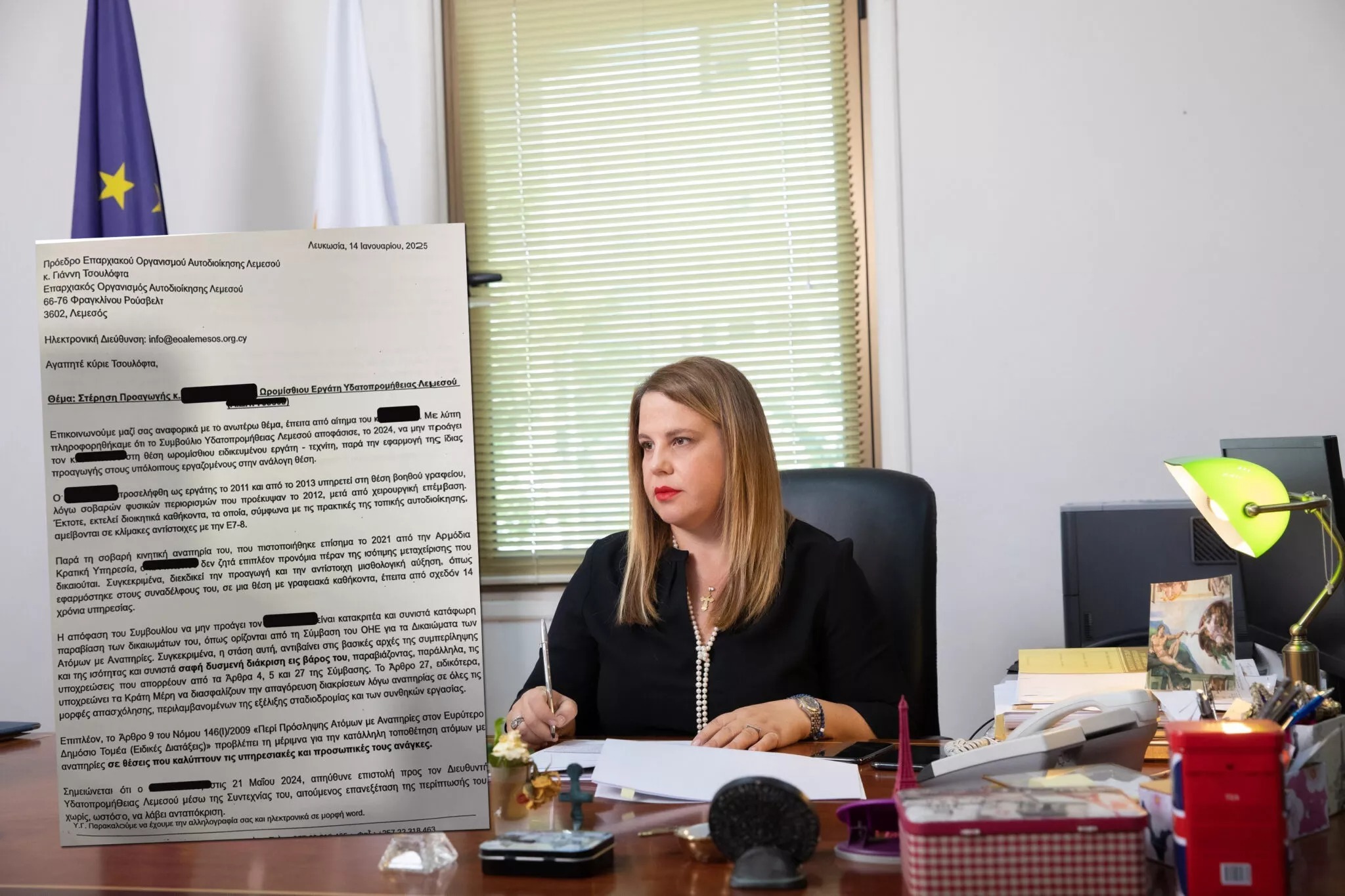
    An employee with disabilities claims he was unfairly denied a promotion, sparking a complaint to Cyprus’ Commissioner for Administration and Human Rights. The complaint, filed last Thursday by lawyer George Karapatakis, represents a former employee of the Limassol Water Board, which has been dissolved and integrated into the Limassol District Local Government Organisation (EOA).

    The complainant, a father of three, suffers from a serious spinal disability following surgery. Despite his challenges, he has continued to fulfil his job responsibilities from a different position with commitment. Notably, he is not wheelchair-bound and manages to commute independently.

    Karapatakis argues that his client was overlooked during a promotion process at the Limassol Water Board in spring 2024. He asserts that this decision was influenced by the employee’s health condition. To support this claim, the lawyer references the promotion of two other workers who had been appointed in the same year as his client, suggesting that the promotion criteria may not have been applied consistently.

    In his appeal, Karapatakis draws attention to the fact that individuals with disabilities are typically promoted within security bodies like the Police and National Guard without negative repercussions. He also mentions similar practices in the Civil Service and the wider public sector, implying that his client’s situation is an exception rather than the norm.

    The issue is complicated by the status of the Limassol Water Board, which no longer exists as a legal entity. In a response letter, Sokratis Metaxas, the General Director of the EOA and former director of the Water Board, stated that there is no authority to intervene in previous promotions because of this dissolution. He acknowledged that he participated in the promotion process in question.

    Metaxas addressed the situation after being informed of the complaint. While he refrained from discussing specific personal circumstances, he emphasised that the contributions of the affected employee would be recognised and valued in the future. He defended the promotion decisions made, asserting that they were in the best interest of the service and reflected appropriate sensitivity to all employees’ circumstances.

    The legal argument presented in the complaint highlights the serious implications of alleged discrimination based on disability. It references relevant legislation and European directives, stressing that employment for individuals with significant disabilities is essential for their self-esteem, social integration, and personal fulfilment. Karapatakis states, “Work not only enhances the physical and psychological well-being of these individuals but also reduces the feeling of isolation.”

    The complaint concludes with a strong assertion that discrimination has occurred in the employee’s career development due to his disability. Karapatakis hopes for decisive action from the Commissioner, urging that the alleged discrimination be addressed.