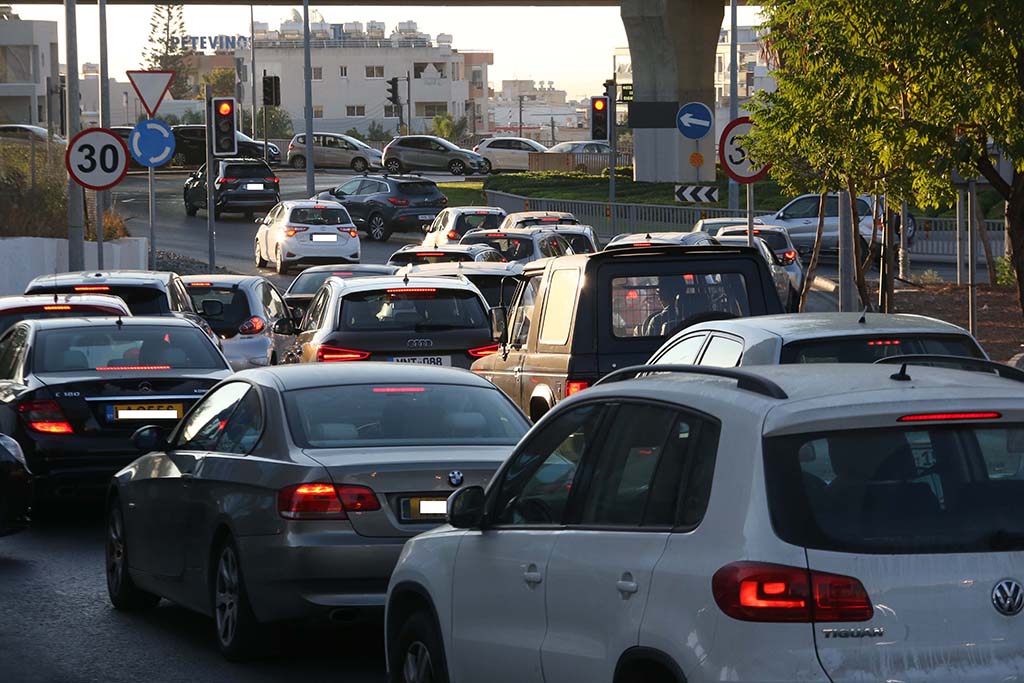
A new bill proposes key measures to ease traffic congestion, addressing management of obstruction in school zones, staggered working hours, and the publication of traffic flow indicators.
- A new bill proposes key measures to ease traffic congestion, addressing management of obstruction in school zones, staggered working hours, and the publication of traffic flow indicators.
- Funding for the bill will be sourced from the traffic management fund, supported by resources from the recovery and resilience fund, the European cohesion fund, and the transport ministry.
Disy MP Fotini Tsiridou, who submitted the bill on Monday, emphasised the need for a comprehensive, realistic, and fair approach that will not burden citizens. “This proposal aims to change the mentality of travel and upgrade our quality of life,” she stated.
The road network decongestion and sustainable mobility law sets ambitious targets, including a 20 per cent reduction in peak-time travel in major roadways, a 25 per cent increase in public transport usage, and a 50 per cent reduction in parking violations within bus lanes and flow zones.
According to Philenews, the proposed bill includes the establishment of traffic management centres (TMCs) for each district, operating under the transport ministry’s oversight. These centres will coordinate traffic lights, manage priority lanes for buses and multi-passenger vehicles, handle towing and road incidents, and publish monthly data on delays and emissions.
In an effort to promote public transport, the bill aims to expand and protect priority lanes while creating multiple passenger travel lanes for cars carrying at least three individuals. Each district will be required to designate at least three ‘flow zones’ where stopping or parking will be prohibited from 7am to 7pm. Vehicles parked in these areas will be towed within ten minutes at no cost to the driver, following an approved safety and transparency protocol.
To enhance safety for students, the bill proposes establishing 200-metre school zones around each educational institution. During peak arrival and departure times for students, these zones will only be accessible to school buses, parents, residents, and emergency vehicles. The police and municipal authorities will oversee these zones to ensure compliance.
Another measure within the bill focuses on distributing working hours in the public sector across three time zones: 7am to 3pm, 8am to 4pm, and 9am to 5pm, aiming to reduce simultaneous traffic. Private companies with over 50 employees will be required to submit a mobility plan that includes staggered hours or teleworking for at least one day per week for 20 per cent of their workforce.
Transparency and public access to data are significant components of the proposed legislation. The ‘Open Cyprus Traffic System’ is set to launch, providing monthly updates on delays, emissions, and violations. Access to this data will be free for all users, ensuring no personal data is processed or published.
Funding for the bill will be sourced from the traffic management fund, supported by resources from the recovery and resilience fund, the European cohesion fund, and the transport ministry.