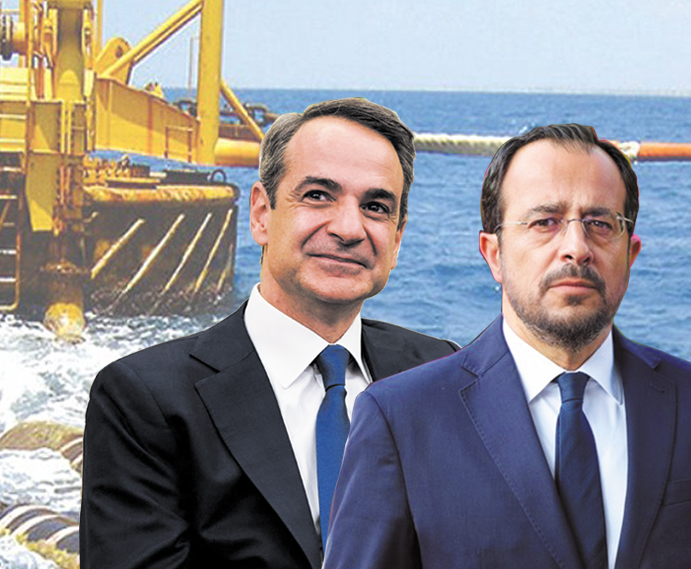
great sea — A longstanding difference over payment structures is at the heart of the ongoing dispute involving the Great Sea Interconnector (GSI) project. Sources revealed that the energy regulator of Cyprus is at odds with Admie, Greece’s independent power transmission operator and the project promoter for the GSI.
- In a clarification issued after President Christodoulides’ remarks, Admie stated it was not demanding the entire €251 million immediately but was contesting Cera's verification of €82 million.
The issue resurfaced following strong comments made by Cypriot President Nikos Christodoulides, who asserted that the state would not be “blackmailed” by Admie. This statement came in response to a report from the daily Phileleftheros, which highlighted the tensions surrounding the project.
President Christodoulides reiterated that there is “no crisis” between the governments of Cyprus and Greece, despite the apparent disagreements over the GSI. He acknowledged that some “technocratic differences” exist regarding the project.
On Monday, the Cyprus energy regulatory authority (Cera) confirmed it had received a letter from Admie concerning its expenses on the GSI. The letter, dated September 26, appeals a previous decision made by Cera in July, where only €82 million in capital expenditures (capex) was verified by the regulator. In contrast, Admie claims it has spent €251 million to date.
In a clarification issued after President Christodoulides’ remarks, Admie stated it was not demanding the entire €251 million immediately but was contesting Cera’s verification of €82 million.
This disagreement stems from a history of disputes dating back to when EuroAsia Interconnector Ltd, a Cypriot company, was the original project promoter. After EuroAsia withdrew in October 2023 due to financing issues, Admie took over but found the existing agreement with Cera unsatisfactory. The previous agreement allowed for some expense recovery only after project completion, while Admie insists on the ability to recoup costs as they occur.
Differences in regulatory practices between Cyprus and Greece exacerbate the situation. In Cyprus, it is customary for the implementing entity to be reimbursed after completing a project, whereas Greece permits reimbursement of expenses as they arise. This fundamental disagreement remains unresolved, with Admie’s recent letter being the latest development in ongoing discussions.
Cera has not accused Admie of dishonesty regarding the €251 million claim; rather, it has requested evidence in the form of invoices to support the expenditure. Currently, Cera maintains that only €82 million can be substantiated.
In July 2024, Cyprus and Greece entered into an interstate agreement committing Cyprus to pay €25 million annually into the GSI project from 2025 to 2030, totalling €125 million. However, this agreement does not address the core issue of when expenses can be reimbursed, leaving Admie’s costs to accumulate.
It’s important to note that the €251 million claimed by Admie does not represent Cyprus’ total liability. Cyprus is responsible for 63% of that amount, while Greece covers the remaining 37%, as per the agreed division of costs.
The overall cost of the interconnector project is estimated at €1.9 billion, and as time progresses, Admie’s financial claims may increase beyond the current figure. Complicating matters further is the ongoing Turkish interference, which has halted depth surveys necessary for mapping the subsea cable route. So far, surveys have only been conducted in the territorial waters off Crete and Cyprus, with Turkish claims of continental shelf rights preventing exploration in international waters. This leaves significant gaps in the necessary seabed mapping for the project.
Leave a Reply